
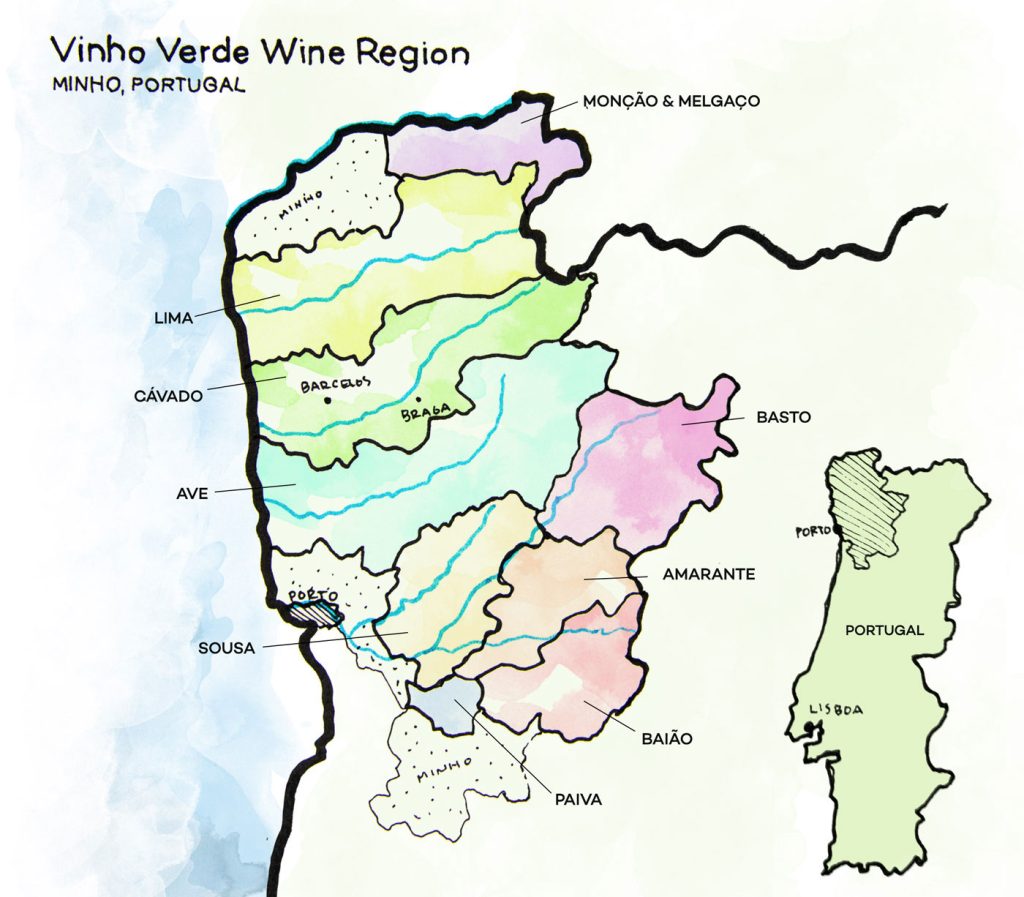
Vinho Verde is located in Portugal’s cool, verdant northwest, bordered by the Minho River to the north, the Douro River to the south, the Atlantic Ocean to the west and a series of mountain ranges to the east. It is Portugal’s largest demarcated wine region and one of its most distinctive and historically significant. Its name, which translates as “green wine,” refers to the lush, green landscape rather than the colour or age of its wines.
Viticulture in the region dates back more than 2,000 years, to Roman times. It was officially demarcated in 1908, making it one of Portugal’s oldest designated wine regions. Interestingly, red wines were historically particularly important here and were once the region’s most prominent style. While red, rosé and sparkling wines are still produced, Vinho Verde is now best known for its vibrant white wines, made predominantly from indigenous Portuguese grape varieties such as Alvarinho, Loureiro, Arinto, Trajadura and Avesso.
The climate is primarily Atlantic maritime, characterized by mild temperatures, high humidity and abundant rainfall, averaging approximately 1,200 mm annually. Rainfall is greatest in spring and autumn, while summers are generally mild, although warmer and drier conditions prevail farther inland.
The region’s geography plays an important role in shaping its wines. A network of river valleys carries Atlantic influences inland, while mountain ranges create natural barriers and contribute to variations in temperature, rainfall and vineyard exposure. These differences give rise to numerous microclimates, allowing a diverse range of indigenous grape varieties to thrive.
Soils are predominantly granite-based, typically shallow, sandy and acidic, although schist and alluvial soils are also found in certain areas. The combination of granite soils, abundant rainfall and relatively cool growing conditions helps preserve the naturally high acidity and freshness that characterize many Vinho Verde wines.
Traditionally, Vinho Verde was associated with light-bodied, refreshing wines, often with a slight spritz of natural effervescence and relatively modest alcohol levels. Today, however, the region has evolved considerably. An increasingly ambitious generation of producers is moving beyond this traditional style, focusing on still wines, single-varietal bottlings and more premium expressions that showcase the individuality of both grape variety and terroir. Many of these wines offer greater depth, complexity and structure, with some possessing impressive potential for bottle ageing.
While the region remains synonymous with fresh, lively and approachable whites, modern Vinho Verde is proving to be far more diverse and sophisticated than its traditional reputation might suggest.