
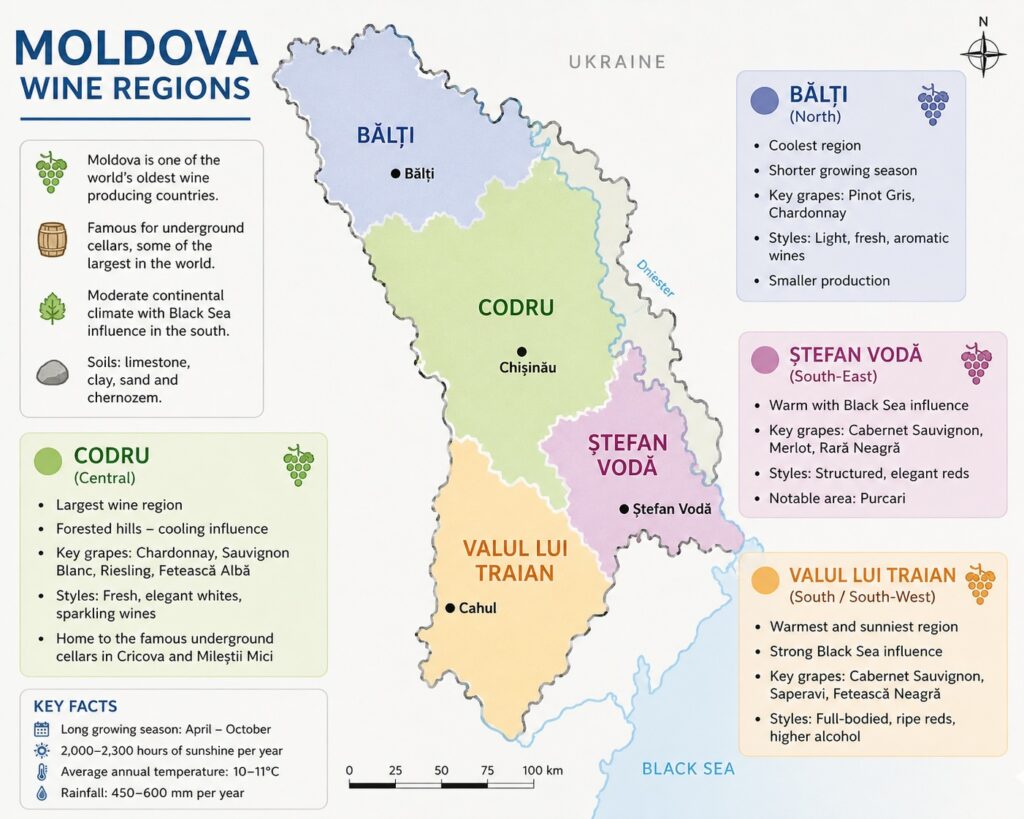
With nearly 10% of its land covered in vines, Moldova boasts one of the highest density of vineyards per person in the world! It is also one of the most ancient wine regions, with a winemaking tradition that dates back more than 5,000 years and a deeper, older connection to the industry than many of its Western counterparts. Nestled between Romania and Ukraine, in the northeast corner of the Balkans not far from the wind swept shores of the Black Sea, this small former Soviet republic has exceptional conditions for viticulture: temperate Continental climate (moderate winters and long, dry autumns); 320 sunny days a year with moderating influences from the Sea; nutrient-rich black soil; and rolling slopes and rocky hillsides scattered between dense forest and meandering rivers.
Like all former Soviet states, high yields and mass production dominated the industry for much of the 20th Century, when every 4th bottle of wine consumed in the U.S.S.R was made in Moldova. In 1994, three years after the country gained independence, it set the first Law on Vine and Wine aimed at establishing production standards, protecting geographical indications and setting quality controls in the viticultural sector. Today, Moldova is the 11th largest European wine-producing country and has shifted its focus from industrial quantity to high quality boutique and premium production. There are three distinct PGIs (regions) — Codru, Stefan Voda and Valul lui Traian — each with its own strengths, focus, terroir and style.
International grapes make up almost 70% of plantings in the country, chief among them Cabernet Sauvignon, Merlot, Pinot Noir and Chardonnay. However, the true excitement here lies in their native grapes Fetească Albă, Regală, Viorica, Fetească Neagră and Rara Neagră. Perhaps the one with the greatest potential to show both its singular profile and the country’s terroir is the Georgian grape, Saperavi. It is planted widely throughout Moldova and features prominently in its most celebrated wines. Its pulp and juice are pink rather than clear and it is incredibly high in anthocyanins, which provide colour and structure in the glass. It imparts heady aromas of smoked plums, black currant and blackberry.
Moldova is an ancient country with a new wine story—a hidden Eastern Europe gem that is absolutely worth discovering!